

Yes, Invisalign can correct many cases of crowded teeth, though how complex that treatment gets depends on several things. How much space is missing, which teeth are out of position, and how severely any teeth are rotated all matter. So does the patient’s bite, arch shape, root position, gum and bone health, and how any extra space can safely be created.
Crowding isn’t just a matter of “crooked teeth.” At its core, dental crowding is a space problem. It happens when the arch space in the mouth is smaller than the space the teeth actually need, a mismatch dentists in Huntingdon Valley 19006 see often in adult patients. The result is a type of malocclusion, with teeth that overlap, rotate, or sit displaced from where they should be.
That space deficiency is only part of the story. Treatment complexity also depends on how the teeth need to move, the patient’s bite, and the strategy used to create space safely. Invisalign uses clear aligners to guide that tooth movement, sometimes with help from attachments, interproximal reduction, or arch development, an approach First Class Dental applies for patients throughout Lower Moreland and Jenkintown.
Understanding what drives that complexity can make the first Invisalign consultation feel less like a guessing game.
What Does Dental Crowding Mean?
Dental crowding happens when there isn’t enough room in the dental arch for every tooth to sit where it should. Teeth respond by overlapping, twisting, or erupting out of alignment.
Common results include:
- Overlapping or rotated teeth
- Teeth that erupt too far forward or backward
- Displaced canines
- Crowded, irregular front teeth
- Tight contacts between teeth that are hard to clean
Crowded teeth can affect more than appearance. They can change how the bite fits together and make oral hygiene harder. Over time, this kind of orthodontic crowding can also put extra strain on gum tissue and affect how stable the smile stays. Dentists often describe these alignment issues as a bad bite, or malocclusion, and crowded, spaced, or misaligned teeth are among the most common reasons people seek orthodontic treatment.
Why Teeth Become Crowded
Crowding usually comes down to a mismatch between tooth size and arch size. Some patients simply inherit jaw dimensions that are smaller relative to their tooth size.
Other contributing factors include early loss of baby teeth, eruption patterns that push teeth out of sequence, and gradual shifting that happens over years. Teeth that moved with braces earlier in life can also drift back, a pattern known as orthodontic relapse.
It’s rarely just “not enough jaw space.” Tooth size, arch dimensions, tooth position, and the order in which teeth erupted all play a role together.
Crowded Teeth vs Crooked Teeth: Are They the Same?
Not exactly. “Crooked teeth” is a general description of how teeth look or sit. Crowding is more specific because it refers to an actual space deficiency in the dental arch.
A single tooth can be rotated or crooked without the patient having generalized crowding. That distinction matters, because it changes how a dentist plans treatment.
Can Invisalign Straighten Crowded Teeth?
Invisalign can treat many mild, moderate, and select complex crowding cases. But clear aligners don’t shrink teeth or create room out of nothing.
Treatment has to create space, redistribute existing space, or both, while moving teeth into healthier positions. Depending on the case, that tooth movement might involve arch development, controlled expansion, interproximal reduction, or rotation correction. Some plans also call for distal movement of back teeth or, in select cases, extraction. Not every method applies to every patient, so which combination makes sense depends entirely on the diagnosis.
How Clear Aligners Create Space for Crowded Teeth
Aligners work by applying gentle, staged pressure that repositions teeth over time. Within biological limits, they can also broaden or coordinate the shape of the dental arch. This kind of orthodontic tooth movement can open tight contact points, create controlled spacing where teeth are bunched, and redistribute space that already exists in the mouth.
This is where space creation for Invisalign crowded teeth cases differs from patient to patient. Someone with mild rotation needs a very different plan than someone with several overlapping teeth across the front of the arch.
Why Root Position Matters as Much as Visible Tooth Position
The crown of a tooth, the part you see when you smile, can look aligned before the root underneath is actually where it needs to be.
Root position affects long-term stability, periodontal support, how contact points sit between teeth, and the overall bite. Move a crown without properly guiding the root, and the result can drift or relapse later.
This is a big reason dentists rely on digital treatment planning. Simulating tooth and root movement in advance helps confirm that a plan is stable, not just cosmetically straight on day one.
What Determines Whether Crowding Is Mild, Moderate, or Complex?
There isn’t one number that sorts crowding into neat categories. Complexity comes from several factors interacting at once. These include total space deficiency, how many teeth are affected, the degree of rotation, root position, bite relationship, arch shape, and periodontal support.
Amount of Missing Space in the Dental Arch
The more space that’s missing, the more space management and tooth movement a treatment plan generally needs. This is the starting point for most evaluations, but it’s never the whole picture.
Number and Location of Crowded Teeth
A single displaced incisor is a very different case than crowding that runs across an entire arch. Anterior crowding, lower front teeth crowding, upper arch crowding, canine displacement, and posterior involvement all call for different planning.
Degree of Tooth Rotation
Teeth that are severely rotated often need more control to move predictably. That can mean attachments, more monitoring, and additional tooth movement built into the plan. Rotation is closely tied to how attachments get used, which is worth understanding on its own.
Bite Problems That Occur Alongside Crowding
Crowding doesn’t always show up alone. It can appear together with an overbite, crossbite, open bite, deep bite, or uneven contacts between the upper and lower teeth.
When bite issues and crowding overlap, the dentist has to plan for alignment and function at the same time. That combination is one of the biggest reasons two crowding cases that look similar can require very different treatment.
How Dentists Create Space During Invisalign Treatment
Every crowding case eventually comes down to one planning question: where will the space needed for straighter teeth actually come from?
Arch Development and Controlled Expansion
In some cases, aligners can shift tooth positions across the arch to gain usable space through arch coordination and controlled tooth movement. This kind of arch development is different from surgically expanding the jaw itself, which isn’t part of typical adult Invisalign treatment. The goal is dental expansion within the limits of what the teeth and supporting bone can safely accommodate.
Interproximal Reduction (IPR) Between Teeth
Interproximal reduction, often called Invisalign IPR, is a small, controlled amount of enamel reduction between selected teeth to create limited extra space. It’s conservative by design and used only where the plan calls for it, not automatically applied across every case.
Some patients need this kind of space creation to help distribute room evenly across the arch. Others don’t need it at all. It comes down to how the specific case is diagnosed.
Moving Teeth Into Available Space
Beyond expansion and IPR, treatment can redistribute existing spacing and move posterior teeth to open room toward the front. It can also coordinate where teeth sit across the arch and correct how far individual teeth are tipped. The exact combination depends on the diagnosis, which is why two patients rarely get identical plans.
When tooth extraction may be considered
For select cases of severe crowding, extraction can be part of an orthodontic plan, though it’s far from routine. A dentist weighs facial profile, tooth position, bite, arch dimensions, periodontal health, and the overall treatment goal before recommending it.
Extraction is one tool among several, used only when the space deficiency and treatment goals genuinely call for it.
How Invisalign Attachments Help Correct Crowded and Rotated Teeth
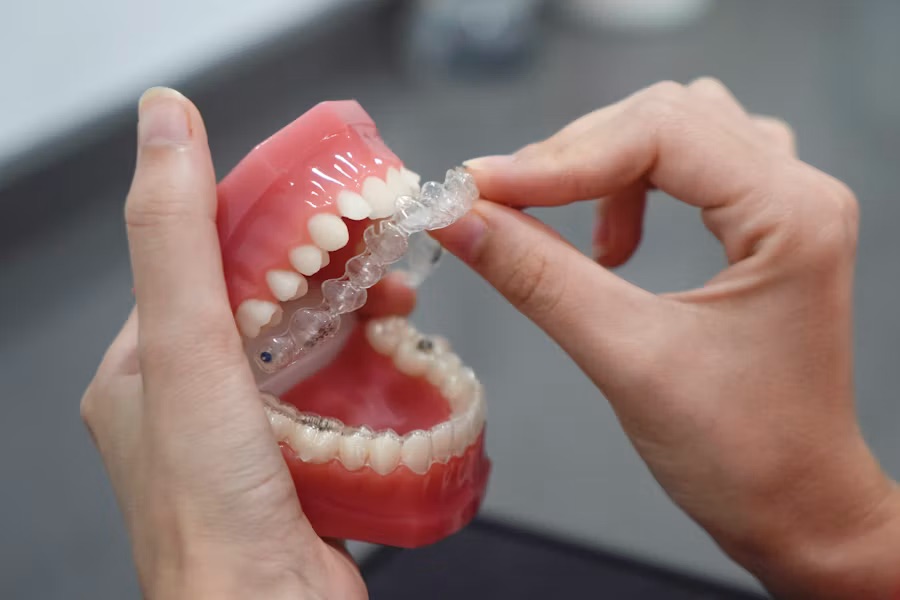
Invisalign attachments are small, tooth-colored shapes bonded temporarily to certain teeth. They give the aligner more to grip, which improves control over rotations, root movement, extrusion, and controlled tipping. A plain aligner surface can’t manage these movements as precisely on its own.
Attachments come up often in crowding cases involving rotated teeth, since rotation is one of the harder movements for aligners to control without extra help.
Can Invisalign Treat Severe Crowding?
Modern clear aligner treatment can manage increasingly complex cases. Severe crowding may call for more significant space creation, attachments, elastics, IPR, extractions in select cases, complex sequencing of tooth movement, or alternative orthodontic mechanics.
That doesn’t mean severe crowding is off the table for Invisalign. It means the plan is more involved, and a thorough evaluation is what determines whether aligners are the right fit.
Why Severe Crowding Is More Than a Cosmetic Problem
Overlapping tooth surfaces are harder to keep clean. That makes plaque retention more likely, which can lead to gum inflammation, uneven wear on tooth surfaces, and interference with a healthy bite.
Treating crowding isn’t only about how the smile looks. It’s also about reducing the daily hygiene challenge that comes with teeth that overlap.
When Traditional Braces May Be Considered Instead
For some very difficult tooth movements, traditional braces can offer a level of mechanical control that’s hard to match with aligners alone. Whether that applies to a specific case comes down to clinical diagnosis rather than a general rule.
Can Invisalign Fix Crowding in the Lower Front Teeth?
Lower front teeth, technically the mandibular anterior teeth, are one of the most common places crowding shows up in adults. The lower arch tends to have less available space to begin with, which makes it more prone to rotation and gradual shifting.
Why Lower Front Teeth Can Become More Crowded Over Time
Several things contribute to this pattern together, not any single cause on its own. Natural tooth movement continues throughout adulthood. Periodontal support can change over time. Teeth that were straightened with braces years ago can relapse, especially without consistent retainer use. Even small shifts in how teeth contact each other can nudge things out of alignment.
Age is part of the picture, but it’s rarely the whole explanation.
Can Invisalign Treat Crowding After Previous Braces?
It’s common for adults to consider Invisalign because teeth shifted after braces earlier in life. When that happens, treatment planning has to look at more than just the current alignment.
A thorough evaluation considers current tooth position, whether the original bite correction has held, how much space is available now, root position, and retainer history. That history often shapes how the new plan gets built. Retainer habits after the first round of treatment are usually what determine whether relapse happens again, a topic worth understanding on its own before starting a second course of treatment.
Does Crowding Affect Gum Health and Oral Hygiene?
Overlapping tooth surfaces make brushing and flossing more difficult. That, in turn, can make plaque removal less effective in the tight spots between crowded teeth.
Gum disease is an infection of the tissues that support the teeth, often linked to plaque that isn’t fully removed during daily brushing and flossing. Straightening crowded teeth doesn’t automatically cure existing gum disease. If a patient has active periodontal issues, those need evaluation and management before or alongside orthodontic treatment. That’s one reason a dental cleaning and exam is often a starting point before Invisalign begins.
How Digital Treatment Planning Evaluates Invisalign Crowding
A crowding case can’t be fully assessed from a photo or a quick look in the mirror. Digital treatment planning typically includes intraoral scanning, digital dental models, and bite analysis. It also evaluates tooth position, arch form, and spacing requirements, then simulates how teeth are expected to move.
That level of detail is also used to plan where attachments will go and how much movement each stage of treatment should accomplish.
Why Two Patients With Similar Crowding May Need Different Treatment
Two people can look like they have nearly identical crowding and still need very different plans. Root position, tooth dimensions, arch dimensions, and gum and bone support can all differ beneath the surface. So can bite relationships, degree of rotation, and how each patient’s tissue responds to movement.
That’s the gap between what crowding looks like and what it actually requires to correct. It’s exactly what a clinical evaluation is built to uncover.
How Long Does Invisalign Take for Crowded Teeth?
Treatment time depends heavily on how much movement is needed. Mild crowding generally requires less overall tooth movement than moderate or severe cases. When crowding overlaps with a bite issue, treatment tends to involve more stages.
Patient compliance, meaning how consistently aligners are worn, also affects how treatment progresses. Some cases need refinement aligners partway through to fine-tune the result. Because timelines vary this much from case to case, an accurate estimate really only comes from an in-person evaluation.
Does Invisalign Cost More for Severe Crowding?
Cost can depend on several factors: how complex the case is, how many stages of aligners are needed, overall treatment length, how much monitoring is required, and a practice’s fee structure. Insurance benefits can also factor in, depending on the plan.
Crowding severity alone doesn’t set the price. It’s one factor among several that a dentist considers when building a treatment estimate, and patients can review the practice’s financial options for treatment once a plan is in place.
How Dentists Determine Whether Your Crowding Is Suitable for Invisalign
Candidacy comes down to a clinical exam, not a guess based on how crowded teeth look at a glance. Dentists evaluate the amount of crowding, root position, arch dimensions, gum health, bite relationship, whether existing teeth are restorable, and how consistently a patient is likely to wear aligners as directed.
That combination of factors is what determines whether a case is ready for personalized Invisalign treatment or whether another approach makes more sense.
Invisalign for Crowded Teeth in Huntingdon Valley, Lower Moreland & Jenkintown
Adult crowding is common across Huntingdon Valley, Lower Moreland Township, and Jenkintown, and it rarely looks the same from one patient to the next. Digital evaluation and careful clear aligner planning give a much clearer picture than a general estimate. A full look at bite and alignment rounds out that evaluation.
Individualized treatment matters here. A plan built around one patient’s specific crowding, root position, and bite relationship is what actually moves teeth predictably, whether that patient lives in the 19006 zip code or has been part of the practice for years.
Frequently Asked Questions About Invisalign for Crowded Teeth
Can Invisalign fix severely crowded teeth?
Invisalign can treat many levels of dental crowding, including some severe cases. Severe crowding may require additional space-management strategies such as IPR, attachments, or extractions. A thorough evaluation determines whether Invisalign is suitable for a specific case.
How does Invisalign make room for crowded teeth?
Invisalign treatment can create space through controlled tooth movement across the arch. Selected cases may also use interproximal reduction or arch coordination to gain additional room. Treatment planning determines which space-creation strategy fits the case.
Does Invisalign work for overlapping teeth?
Clear aligners can reposition many overlapping teeth into better alignment. Tooth rotation and the amount of available space both affect how complex that movement is. Attachments may improve control over specific, harder-to-move teeth.
Can Invisalign fix crowded bottom teeth?
Invisalign can treat many cases of lower anterior crowding. Available space in the lower arch and the degree of rotation both influence complexity. Consistent retainer use afterward supports long-term alignment.
Is Invisalign or braces better for severe crowding?
Both Invisalign and traditional braces can treat orthodontic crowding. The complexity of the required tooth movement often influences which appliance makes more sense. A clinical diagnosis is what actually determines the appropriate treatment system.
Does crowded teeth treatment require extractions?
Dental crowding doesn’t always require tooth extraction. Severe space deficiency may sometimes call for extraction as part of the plan. Facial profile, bite, and arch dimensions all influence that decision.
Can crowded teeth become worse with age?
Tooth position can continue to change throughout adulthood. Previous orthodontic relapse and periodontal factors may contribute to increasing crowding over time. Retention and regular dental monitoring support long-term stability.
Find Out Whether Invisalign Can Correct Your Crowded Teeth in Huntingdon Valley and Lower Moreland
Crowding looks different in every mouth. The right treatment depends on details a mirror can’t show, including crowding severity, available arch space, bite relationship, and gum health. Tooth movement requirements factor in too, and all of it shapes which orthodontic treatment actually fits.
A consultation is the most reliable way to find out what your specific case needs. If you’re in Huntingdon Valley, Lower Moreland, or still calling Jenkintown home, First Class Dental can walk through your crowding and your bite. From there, we can talk through whether Invisalign or another approach is the right fit for you.
