

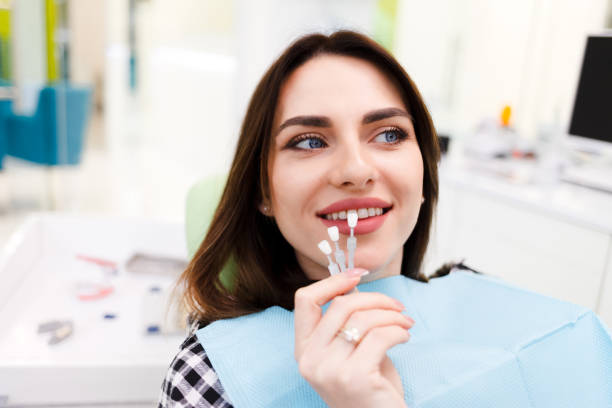
Porcelain veneers can improve teeth that look short, worn down, uneven in length, or out of proportion with their neighbors. Whether veneers for short teeth are the right choice depends on why the tooth looks short in the first place. Your enamel, gum position, bite forces, and the amount of length a tooth can safely carry all shape the answer.
A front tooth can look short for four different reasons. It may be naturally small, worn by grinding, partly covered by gum tissue, or sitting higher than the teeth beside it. Veneers handle some of those causes well. Others call for bonding, orthodontics, gum treatment, or a combination.
That’s why cosmetic planning at First Class Dental starts with measurement before any material is chosen. Dr. Andrew Cohen looks at tooth proportions, the gumline, the bite, and how your teeth sit against your lips when you smile. Our Jenkintown office sees patients for exactly this kind of evaluation. Many of them live in Huntingdon Valley.
Why do some teeth look shorter or more uneven than others?
What you see in the mirror is the visible part of the tooth, called the clinical crown. The anatomical crown, the full enamel-covered portion, may be longer than what shows. Perceived length adds a third layer, shaped by your lip line and the teeth on either side.
So a patient who says “my front teeth are short” may have teeth of normal size. The gums might cover more of them, or the edges might have worn down over years of clenching. Adding porcelain without knowing which is true can produce teeth that look bulky, overly long, or out of place.
Naturally small or short front teeth
Some people are born with smaller incisors. Microdontia describes teeth that are smaller than typical, and it most often affects the lateral incisors beside the two front teeth. A peg-shaped lateral incisor is a common version: narrow, tapered, and noticeably shorter than its neighbors.
In most smiles, the central incisors are the largest and most prominent front teeth. The laterals are narrower and slightly shorter. When a lateral is undersized, the width-to-length balance across the smile looks off. A carefully designed veneer can add width and length to that tooth so it sits in better proportion with the centrals.
Teeth that have become shorter because of wear
Attrition is tooth-to-tooth wear. Over the years, grinding and clenching (bruxism) can flatten incisal edges, chip corners, and shorten front teeth enough to change how a smile looks.
Minor edge irregularities are common and often need little treatment. Significant wear is a different situation, because real tooth structure has been lost. Veneers may be an option for selected worn front teeth. But the forces that wore those teeth down are still present, and porcelain does not stop anyone from grinding. The bite and the cause of the wear need evaluation before a restoration is designed.
Teeth that appear short because of excess gum coverage
Sometimes the tooth is long enough, and the gums cover too much of it. Altered passive eruption describes gum tissue that never fully moved to its typical position after the adult teeth came in. The result can be square-looking teeth and a gummy smile.
Longer veneers are usually the wrong fix here. Adding length at the biting edge pushes the tooth’s proportions further from natural, while the real issue sits at the gumline. A periodontal evaluation can show whether aesthetic crown lengthening or gum contouring would expose more natural teeth. In some plans, that step comes before veneers. In others, it’s the entire treatment.
Teeth that look uneven because of their position
One incisor can look shorter because it sits higher in the gum, tips backward, or rotates slightly. Its crown may be the same size as the tooth beside it. When position is the problem, Invisalign or other orthodontic treatment can move the tooth into line without adding restorative material.
How do porcelain veneers change the length and shape of front teeth?
A porcelain veneer is a thin custom ceramic restoration bonded to the front surface of a tooth. Because it’s designed from scratch, its contours can change how long, wide, and full the tooth appears.
Veneer design for short teeth works on several dimensions at once. These include incisal-edge extension, facial contour, mesiodistal width (side to side), ceramic thickness, and the way the restoration emerges from the gumline. Each one has to fit the available space, the bite, and the tooth underneath. A veneer that adds length without regard for the rest tends to look artificial.
Extending uneven or worn incisal edges
The incisal edge is the biting edge of a front tooth. When edges are worn or uneven, a veneer can rebuild the edge so it lines up with the teeth beside it.
Edge position affects more than appearance. It influences how you pronounce “f” and “v” sounds and where your upper and lower teeth meet. It also shapes anterior guidance, the way your front teeth steer your jaw when you slide it forward. That’s why the amount of extension differs from case to case. Some teeth can take a meaningful amount of added length. Others can take very little before speech or bite contacts change.
Improving tooth width-to-length proportions
Length never gets designed in isolation. A tooth lengthened without attention to width can look narrow and spiky. One widened without enough length can look square.
Natural-looking cosmetic dentistry weighs several factors together. Those include the dominance of the central incisors, the slightly smaller laterals, symmetry between the left and right sides, and the shape of your face. Fixed “ideal” ratios get published often, but real smiles vary, and good design follows your anatomy. If a natural appearance is your main concern, our guide to veneers that look natural covers that question in more depth.
Creating a more balanced smile line
The incisal curve is the gentle line formed by the edges of your upper front teeth. In many attractive smiles, that curve roughly follows the lower lip. When one or two edges break the line, the whole smile can look uneven.
Cosmetic planning brings neighboring edges into better harmony. Identical lengths are rarely the goal. Natural teeth show small differences, and those differences help a smile read as real.
Can veneers fix one short tooth, or do multiple teeth need treatment?
One veneer may be enough when a single tooth has a localized problem and the teeth beside it already look proportional. Several veneers may make sense when multiple teeth need coordinated changes. The right number comes from your exam, and no preset package applies.
Correcting one uneven front tooth
Single-tooth cases are some of the most demanding in cosmetic dentistry. The new veneer has to blend with a natural tooth right next to it. Matching that tooth involves:
- translucency at the edge, where natural enamel lets light through
- color across the body of the tooth
- surface texture and the way it reflects light
- incisal edge height
- the contours of the neighboring teeth
Getting all five right takes careful shade work, and sometimes an extra try-in visit.
Correcting several short or uneven front teeth
When several front teeth are short or uneven, coordinated planning lets their lengths, widths, and edge positions work as a set. Which teeth show in your natural smile matters a great deal. Some people show six upper teeth when they smile, while others show eight or ten.
Healthy teeth shouldn’t be prepared only to make a set look uniform. A sound plan treats the teeth that need it and leaves the rest alone where possible.
When are porcelain veneers better than cosmetic bonding for short teeth?
Both can add length to a front tooth. Porcelain veneers are indirect ceramic restorations made by a dental laboratory, and they can change contour, color, shape, and length together. Composite bonding is a direct resin material sculpted on the tooth in one visit. It suits more limited edge or shape corrections.
For short teeth, the choice usually comes down to six factors:
| Factor | Often Leans Toward Bonding | Often Leans Toward Porcelain Veneers |
|---|---|---|
| Missing Tooth Structure | A small chip or slightly short corner | Lost length across the whole edge |
| Existing Enamel | Enamel largely intact | Enough sound enamel to bond ceramic |
| Extent of Change | One dimension, such as a corner | Shape, color, length, and symmetry together |
| Repairability | Easy to add to or repair chairside | Repairable in some cases, but more involved |
| Bite Forces | Light contact on the edge | Bite can support a ceramic edge |
| Long-Term Maintenance | Periodic polishing or touch-ups | Stain-resistant surface with routine checks |
When minor edge differences may be corrected with bonding
Bonding is a conservative way to even out a small chip or a slightly short corner. It often requires little or no enamel removal, and it can be adjusted later. For a minor discrepancy, it may be the most sensible first step.
When larger cosmetic changes may favor porcelain veneers
Porcelain becomes more appealing when a patient wants to change several things at once, such as shape, color, length, and symmetry across multiple teeth. Ceramic holds its surface finish and color well over time. Suitability still depends on how much healthy tooth structure remains and whether the bite can support the planned edges.
When will veneers alone not correct short-looking teeth?
Veneers fall short when the cause sits outside the tooth’s shape. Gum position, tooth position, and severe wear each need their own answer first.
When gum position needs to be evaluated first
If excess gum tissue is hiding natural teeth, longer veneers would only make the edges look stretched. Crown lengthening or gum contouring can expose more of the natural tooth in appropriate cases. A periodontal evaluation determines whether that applies. If a procedure is needed, we’ll explain where it would be performed and how it fits your veneer timeline.
When orthodontic tooth movement is more appropriate
An incisor that sits too high may need to move down rather than be lengthened with porcelain. Dentists call that movement extrusion. Intrusion moves a tooth up into the gum, and changes in inclination tip a tooth forward or back. Clear aligners can make these movements in many adult cases. If you’re weighing the two approaches, our article on Invisalign versus veneers explains how to decide.
When significant wear requires bite rehabilitation
Severe wear rarely stops at the front teeth. When back teeth have flattened too, the bite may have lost height, and the front teeth can take on extra load. Placing isolated veneers on worn incisors in that situation raises the risk of chipping or debonding. A full bite assessment comes first, and treatment may involve restoring more teeth than the ones you see when you smile.
How do gumline shape and bite alignment affect veneer length?
A veneer has two ends, and both have to look right. One is the margin near the gums, and the other is the edge where you bite. A problem at either end shows quickly in a smile.
The relationship between gumline height and visible crown length
The gingival margin is where the gum meets the tooth. The gingival zenith is the highest point of that curve on each tooth. When two teeth of the same size have different gumline levels, one can look noticeably shorter. Changing the veneer edge can’t correct a gumline difference, so both ends get evaluated together.
Why bite forces limit how much length can be added
In most bites, the lower front teeth touch the backs of the upper front teeth. Overbite depth, an edge-to-edge bite, and habits like clenching all affect how much force lands on a lengthened edge. Ceramic that extends too far past its tooth support is more likely to fracture. Good veneer design respects how you chew and move your jaw, even when a longer tooth might photograph better.
How are porcelain veneers designed for short or uneven teeth?
Measurements guide every decision in the process. A typical sequence at our office looks like this:
- A clinical exam of your teeth, gums, enamel, and existing restorations
- Digital photographs of your smile at rest and in motion
- Intraoral scanning for a precise digital impression, without traditional putty trays
- Evaluation of tooth dimensions and proportions
- Bite analysis, including how your front teeth guide jaw movement
- A proposed shape and length, reviewed with you before any preparation
- Shade selection to match or brighten your natural color
- A provisional or mock-up review when appropriate, so you can see and feel the planned length
- Final bonding, a bite check, and a follow-up visit
How do dentists determine the right tooth length?
No single formula sets the correct length. Dr. Cohen looks at how much of your upper teeth show when your lips are relaxed and how much shows in a full smile. He also checks how the edges sit against your lower lip. Speech helps too, since “f” and “v” sounds show whether the edges meet the lower lip where they should. Your neighboring teeth and facial proportions round out the picture.
Why a smile preview cannot guarantee the final result
Digital previews and mock-ups are planning and communication tools. They show the direction of the design. The final ceramic is still shaped by your real tooth structure, bite, and gum tissue. For more on how preview software fits into planning, see our article on digital smile design.
How long do veneers for short teeth last?
A veneer that adds length to an edge carries more stress than one that only changes color. Its lifespan depends on several things:
- the material and design of the restoration
- how much of the veneer bonds to enamel rather than dentin or older fillings
- bite loads on the extended edge
- grinding or clenching
- daily oral hygiene
- trauma, such as a fall or a sports injury
- regular dental evaluations
No dentist can promise a specific number of years. Protecting lengthened edges and keeping up with checkups gives your veneers the best chance of lasting.
Can lengthened veneer edges chip?
They can. Porcelain that extends past its tooth support, heavy contact during jaw movement, and nighttime grinding all raise the risk. A higher risk doesn’t mean failure is inevitable, though. Careful design, bite adjustment, and a custom nightguard for patients who grind help manage that risk. Small chips can sometimes be repaired, while larger fractures may require a new veneer.
Who is a good candidate for veneers to correct short or uneven teeth?
You may be a good candidate if you have:
- healthy teeth with concerns about size or proportion
- localized wear along the incisal edges
- naturally undersized teeth, such as peg-shaped laterals
- a visible asymmetry between front teeth
- enough healthy tooth structure to support bonding
Some findings call for different care first. Untreated decay and active gum disease need treatment before cosmetic work begins. Heavy grinding or a collapsed bite needs a functional plan. Major tooth-position problems may be better handled orthodontically. If your situation fits the first list, learn more about our custom porcelain dental veneers and what the process involves.
Porcelain veneers for short teeth near Huntingdon Valley and Lower Moreland
First Class Dental is located in Jenkintown. For patients in Huntingdon Valley (19006), our office is a short drive away. Many of our cosmetic patients also come from Lower Moreland Township. Dr. Andrew Cohen evaluates short or uneven teeth with aesthetics and function in view together. A lengthened edge has to look right in photos and hold up through years of daily chewing. Our team serves families and professionals across Montgomery County who want that kind of careful planning.
Frequently asked questions about veneers for short teeth
Can porcelain veneers make short teeth look longer?
Yes, in many cases. Porcelain veneers can change the visible length and contour of short teeth. Your enamel and bite influence how the restoration is designed. A clinical evaluation determines how much incisal length can be added safely.
Can veneers fix uneven front teeth without braces?
Sometimes. Veneers change tooth shape and visible proportions. Orthodontic treatment changes tooth position. The cause of the unevenness determines which approach works better.
Can veneers correct teeth worn down by grinding?
Some worn teeth can be restored with veneers. Bruxism can contribute to wear along the incisal edges, and veneers may restore selected worn surfaces. An occlusal evaluation guides whether veneers are suitable for your bite.
Do short teeth always need veneers?
No. Short-looking teeth can result from several anatomical and functional causes. Bonding, orthodontics, or periodontal treatment may address some of those causes. Diagnosis comes before choosing any restoration.
How many veneers are needed to correct uneven tooth length?
The number varies. The count of affected teeth influences the scope of treatment, and so do your goals for color, shape, and symmetry. One tooth may need correction, while broader asymmetry may require evaluating several visible teeth.
Explore porcelain veneers for short or uneven teeth near Huntingdon Valley
If your front teeth look short, worn, or uneven, a cosmetic consultation is the place to find out why. At our Jenkintown office, Dr. Cohen will evaluate your tooth length, existing enamel, gumline, and incisal edges. He’ll also check how your bite functions and listen to your cosmetic goals. From there, we’ll talk through which options fit your teeth and your priorities.
Patients from Huntingdon Valley can schedule a cosmetic consultation with our team. We also welcome patients from Lower Moreland who want a clear answer before they commit to treatment.
